
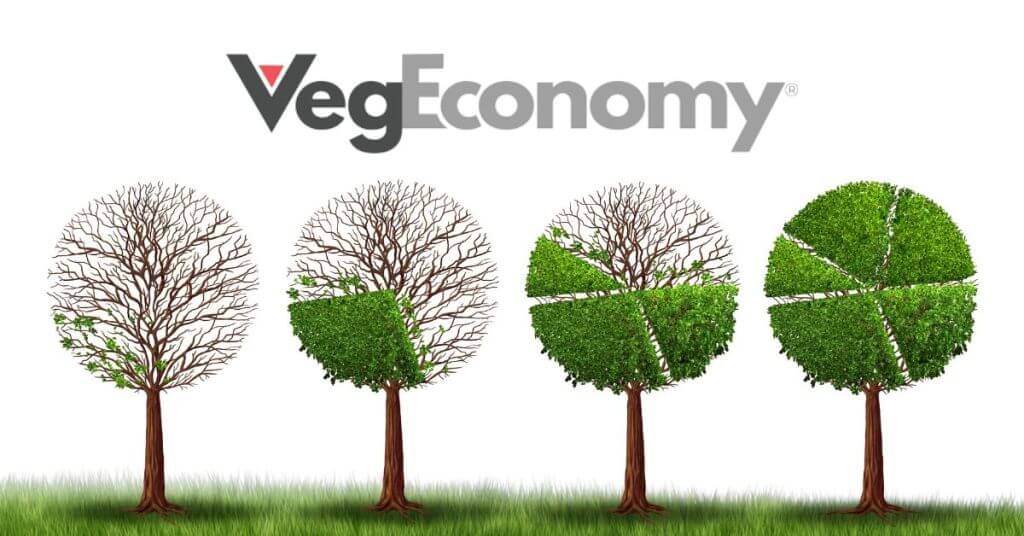
In a capitalist society, “voting with your dollar” may be just as important as traditional voting at the ballot box. Big brand companies look for market trends and adjust their products to the demands of their targeted consumers. No organization wants to go out of business offering products that no one wants, which places power in the hands of the consumer. The supply must match the demand, which makes “winners” and “losers” of product in a democratic choice voting market that can be traced back to the American Revolution when colonists boycotted several British products in protest of taxation without representation. You can see evidence of this today with the development of the VegEconomy.
The term VegEconomy was originally coined in 2019 by the founders of vKind, an online resource and mobile app connecting vegan consumers with vegan businesses. In 2020 an official registration of the mark was granted by the United States Patent and Trademark Office. It was first used by the company to explain the synergies between vegan consumers and businesses in the vegan community. However, the term has become more widely recognized as a metric gaging economic health of the vegan industry at large in vegan vernacular and frequently hash-tagged in social media as #VegEconomy.
The VegEconomy is the current evolution and movement of compassionate and conscious capitalism driven by the demand for the animal-free enterprise. A significant number of businesses are meeting this demand as more vegans and individuals practicing a plant-based lifestyle grow exponentially in numbers around the world. In fact, the global vegan food market size was 23.31 billion USD in 2020. The market is projected to grow from 26.16 billion USD in 2021 to 61.35 billion USD in 2028 at a CAGR of 12.95% during the 2021-2028 period. Search data from Google Trends shows an impressive worldwide increase in interest in veganism from 2004 to 2022, with Google AdWords reporting a growth of 47% in searching for vegan food products.
Consumers realize that consuming meat and dairy products produce more greenhouse gasses than plant-based derived foods. According to Science Journal, dairy and meat products generate 60% of greenhouse gas emissions. Consumers also realize that adopting a vegan diet not only can improve their health and help prevent the exploitation of animals but also help reduce the effects of climate change. They have become aware of what they consume and where it comes from. Because of this realization, the food industry has already responded by offering more vegan options at restaurants, stores, food delivery services, and other venues, with food service fueling the growth of the VegEconomy.
VegEconomy stakeholders do not support or participate in the manufacturing, producing, or selling of any products that have been sourced from animals. Instead, they capitalize on new innovations and cruelty-free practices that both create lucrative opportunities to meet the growing demand and simultaneously foster a harm-free future for animals, people, and the planet. They redefine corporate social responsibility by nurturing an economic ecosystem that preserves precious resources, ends unnecessary suffering of animals, and supports human health. Companies and consumers that embrace vegan principles of stewardship are key to mitigating some of the world’s most perplexing crises, from climate change and environmental contamination to pandemics and starvation.
Businesses and consumers realize that being vegan is more than just a moral choice. It’s about living in harmony with nature to promote wellness of the mind, body, and spirit and achieve optimal health. They know that they have the capacity to transform the means by which wealth is generated on a global scale and how the value of abundance is measured by its positive impact on all living beings.
One way of entering and building the VegEconomy is through the use of Vkind’s app. Vkind is the largest U.S. vegan search platform that makes choosing compassion just as easy as the alternative. Consumers can find the best vegan food, products, professionals, and businesses near them with the ease of a Vkind search, and vegan businesses can list their brands on the site. Vkind’s app helps bridge the gap between conscious consumers and businesses willing to make a positive change for the planet. Vkind’s mission is to make veganism accessible and empower vegan enterprises to thrive in the VegEconomy by offering an easy-to-navigate platform to market themselves to their intended audience. You can learn more about the VegEconmy and about Vkind’s mission by visiting their website at vkind.com.